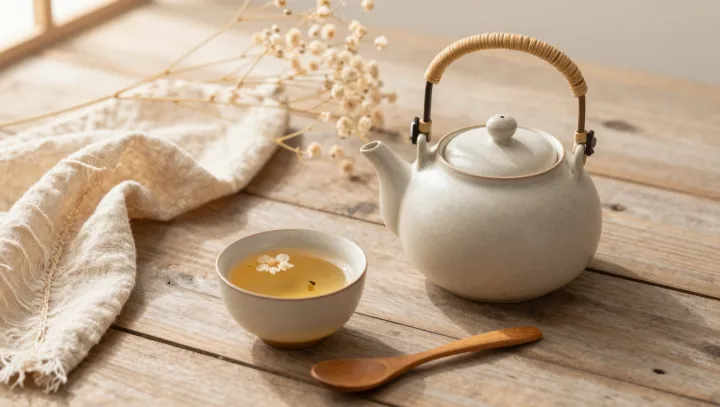
A dried blossom is less a decoration than a compact archive, and when hot water enters its folded tissues, the cup takes on a gold tint as molecules once held behind cell walls disperse into the liquid. Then heat arrives. The cup changes color. What looks like kitchen magic is mostly extraction: rising temperature accelerates diffusion, while water penetrates porous petal tissue and carries soluble pigments outward. Drying has already ruptured some membranes, so water meets a petal partly opened by dehydration rather than a sealed fresh bloom. Aroma follows too. Volatile compounds escape with warm vapor, giving color a scent and turning a quiet steep into a small chemical release.
The color is not always proof of quality. It can mislead. Yellow flavonoids, including chalcones and flavonols, dissolve more readily than many carotenoids, whose poor water solubility limits their contribution. Pigment behavior has rules. Acidity can shift anthocyanin color toward red or blue, though those pigments are not the usual source of a clear gold infusion. The shade also reflects concentration, not merely pigment identity. Steeping is a trade. A hotter, longer infusion can extract more soluble material, yet excessive heat and oxygen may degrade sensitive compounds or flatten fragrance; pH, petal age, drying method, and particle size alter the result. In the amber pause before the first sip, a flower is no longer fixed in a field; it has become evidence that structure, heat, and water can persuade matter to tell its stored story.