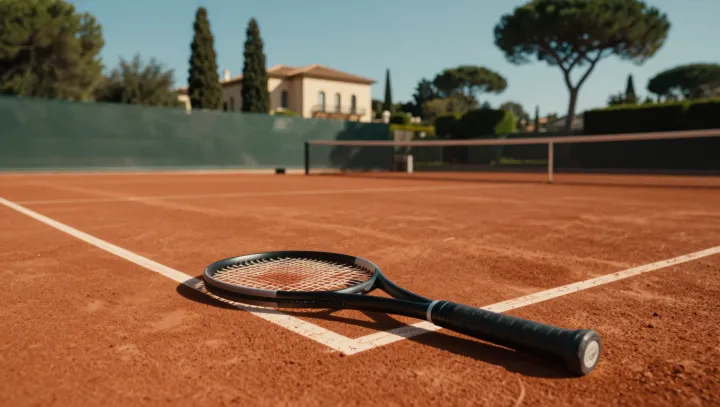
Clay tells the truth. A red smear behind a baseline turns each recovery into evidence: you can see whether a player chose the right angle before the ball arrives, because sliding leaves a visible record of force, balance, and hesitation. You cannot bluff a skid.
That is the trick. Clay's lower coefficient of friction permits controlled deceleration, so players can enter a wide ball with lateral velocity, rotate through the strike, and recover without planting a foot in the abrupt way hard courts demand. The geometry gets cleaner. With more time from the slower bounce, you can read the incoming trajectory, calculate a higher-margin crosscourt lane, and use topspin to pull the ball back inside the sideline. You watch vectors, not bravado. Each slide also teaches constraint: center-of-mass control must remain over a moving base of support, or the stroke collapses. Simple choices survive.
The irony is sharp. Because the surface is scarred by every point, it punishes fuzzy thinking more honestly than polished courts do; a late brake, a poor split step, or an overambitious line is written in dust for everyone to inspect. You get a strange bargain: instability produces precision. Clay strips away the fantasy of perfect footing, then rewards the player who plans the ball's path, the body's path, and the exit path as one problem. Would you call that mess, or proof?