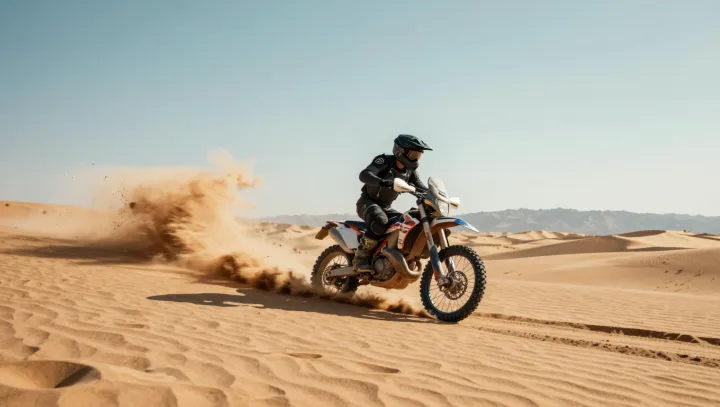
Sand is a treacherous road. Under a rolling tire, grains yield, pile up, and transmit load through transient force chains, so the surface can support a bike one moment and swallow its front wheel the next. Granular rheology, not pavement physics, sets the terms. Traction exists only while the tire limits sinkage and keeps a usable contact patch.
Width wins first. A broad, softly inflated tire spreads the bike's weight across more grains, reducing ground pressure and delaying sinkage. Pressure decides the fight. A narrow, hard tire cuts downward and makes its own rut. Flexible carcasses conform to ridges instead of bouncing across them. In terramechanics, the contact patch works like a load-balancing server, distributing demand before any one node fails. Its real mechanism is stress diffusion through granular media, while tread blocks create shear resistance for forward drive.
Balance is mostly steering. The line will wander. Because loose grains cannot offer a fixed edge, the front wheel drifts and the rider answers with rapid countersteering, measured momentum, and a light grip rather than a rigid line. Gyroscopic precession contributes, but dynamic stability comes chiefly from steering corrections and tire-generated lateral force. Sensor-rich bikes could merge inertial measurement units with torque control, reading incipient sinkage before it becomes a crash. Sand would become a live signal loop.