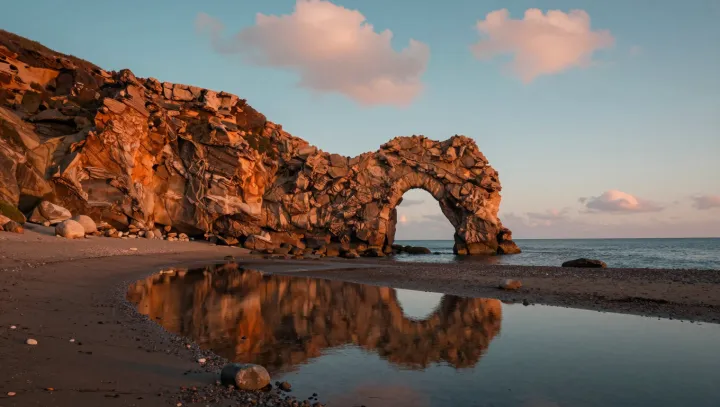
Light gets the first credit, but the rock is the real editor. Across the arch's exposed strata, differential erosion has cut ledges, seams, and undercuts that divide a plain beam into competing planes of shade. Then the tide steps in. Small pools hold pieces of sky, making the site an optical instrument, not a postcard.
Photographers prize this unmarked arch because it refuses a dependable image. At low tide, wet rock increases specular reflection; as water drains, texture returns and the reflected sky breaks apart. At higher water, the pools join, reducing local contrast. Nothing stays fixed. Cloud cover, sea spray, and a low sun alter color temperature and luminance within minutes, while the exposed stratigraphy gives this visual disorder a strict frame.
Its anonymity is an advantage, not a deficiency. Without signage or a prescribed viewpoint, the subject cannot be consumed as a familiar attraction; every exposure must reckon with tide height, wind, and angle of incidence. Rarely does a coastal subject demand so much patience for such a small return. Yet that return can be startling: one aperture may record silver water, dark stone, or a short flare of amber, not because the arch has altered, but because light has. Beneath it, a tide pool keeps the sky briefly, then returns it to the weather.