Gravity is both keeper and saboteur of a planet's rings. It holds countless fragments in orbit, yet its uneven pull can frustrate their attempts to become a moon. The distinction lies in distance: close to a planet, gravity acts more strongly on the near side of a gathering of particles than on the far side.
A ring is less a solid ornament than a crowded orbital society, its members following separate paths. The planet's gravity supplies the inward acceleration that bends those paths around it; the particles' sideways motion keeps them from falling straight in. But neighbors do not share precisely the same orbit. Collisions can make particles stick temporarily, while tidal forces pull at any growing clump. Within a distance called the Roche limit, those tides can overcome the self-gravity of a sufficiently weak body, preventing it from holding together. Strength matters here. Dense, rigid objects can survive where loose aggregates would break apart.
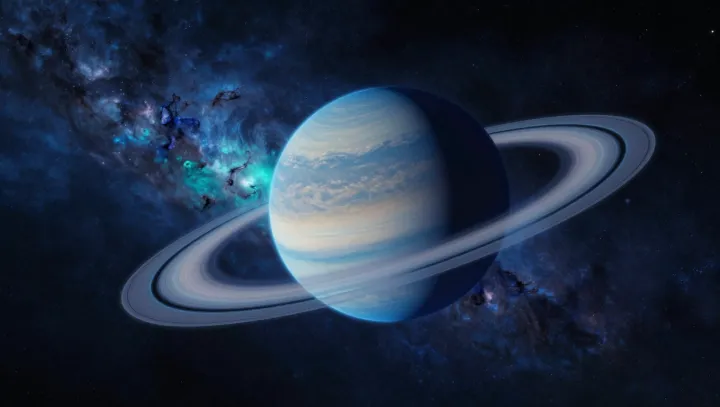
Saturn's rings show that this contest has no single, tidy outcome. They contain mostly water ice, with particles ranging from tiny grains to chunks, and their structure is shaped by collisions and the gravity of nearby moons. Some material can spread outward beyond the region where tides dominate, allowing particles to gather more readily. Rings are not permanent architecture. They are matter caught between two possibilities: remaining scattered around a planet or joining together under its own pull.