A cluster of homes could be more useful than a house beside every field. Proximity made sharing practical. In many farming districts, wells, grazing land and paths served several households, while fields lay beyond the settlement; the extra walk to work bought access to resources that a household might struggle to secure alone.
The village was an economic arrangement, not merely a preference for company. In parts of rural Europe, open-field agriculture divided arable land into strips worked by different households, often under rules that coordinated planting and grazing after harvest. The commons mattered too. Shared pasture and woodland could supply fodder, fuel and other necessities, but access depended on local rights rather than a simple promise that everything belonged to everyone. Neighbors also exchanged labor at harvest and could pool animals or equipment, spreading costs that might otherwise overwhelm a household. Close settlement made such cooperation easier, and in some places offered protection against theft or attack.
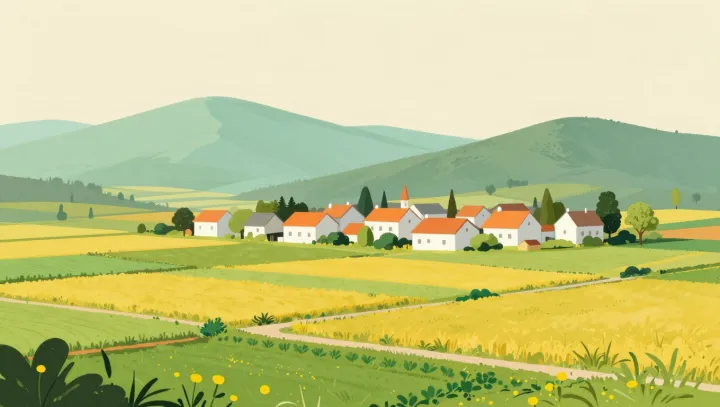
Clustering came at a price. Farmers spent time walking to distant plots, and sharing resources meant accepting restrictions on when animals could graze or fields could be worked. Land tenure shaped who benefited: tenants, landowners and households with different rights to common land did not necessarily enjoy the same security. Nor was village settlement universal; scattered farmsteads made sense where land, water and local institutions favored them. In the illustrated village, the fields stretch beyond the houses, a quiet reminder that the shortest route to a livelihood was not always the shortest walk to work.