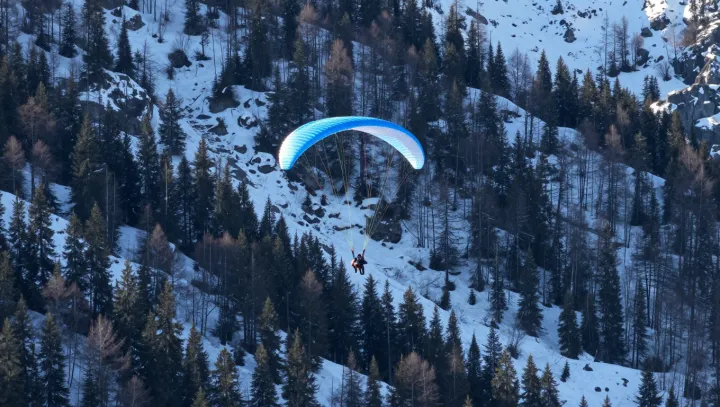
A paraglider can gain thousands of feet while continuously sinking through the air. The distinction is everything. Above a snow-covered mountain forest, the flexible wing may be descending relative to the air around it while that same air rises faster, carrying the wing upward relative to the ground.
The apparent contradiction rests on a simple comparison, not a hidden engine. A wing has a sink rate: the speed at which it descends relative to the surrounding air. If it sinks at one foot per second through air rising at three feet per second, its altitude increases by two feet per second. Rising air wins. One source is a thermal, a column of air warmed by the ground; another is ridge lift, produced when wind encounters a slope and is deflected upward. Snow can limit surface heating, but exposed rock and sunlit terrain may still warm the air unevenly.
Altitude, though, is never a gift without conditions. Thermals can be patchy, ridge lift depends on wind and terrain, and rising air may sit near turbulence or sinking air. A variometer helps a pilot detect changes in vertical speed, but it cannot make the atmosphere steady or turn a poor decision into a safe one. The wing remains unpowered. Its climb is borrowed from moving air, and above the white forest the difference between falling and rising depends on which motion one chooses to measure.