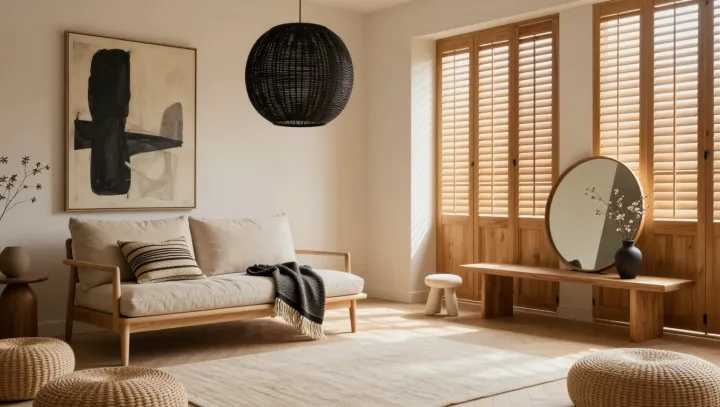
Pale wood slats make a persuasive case for leaving well enough alone. Their grain gives the room a quiet rhythm, while low seating, textured neutral fabrics and black accents keep it from dissolving into blandness. Nothing needs to gleam. The effect rests less on perfection than on the welcome absence of it.
Wabi-sabi offers more than a restrained decorating scheme. Rooted in Japanese aesthetic traditions, it values impermanence and the marks of use, finding beauty in objects that do not pretend to last unchanged. In interiors, that outlook shifts attention from flawless finishes to materiality: the grain of wood, the weave of cloth, the weight of an object in the hand. Patina matters too. A surface altered by use can be understood as acquiring character rather than losing value.
The room feels restful because its materials make no demand for perfection. Low furniture encourages a relaxed posture, while the repeated slats provide order without requiring every surface to look identical; black accents add definition against the pale wood and neutral fabrics. None of these choices guarantees calm. They suggest, instead, a gentler standard for a space that people actually inhabit, where a small irregularity need not become a problem to be corrected. Against the slats, a shadow shifts and passes.