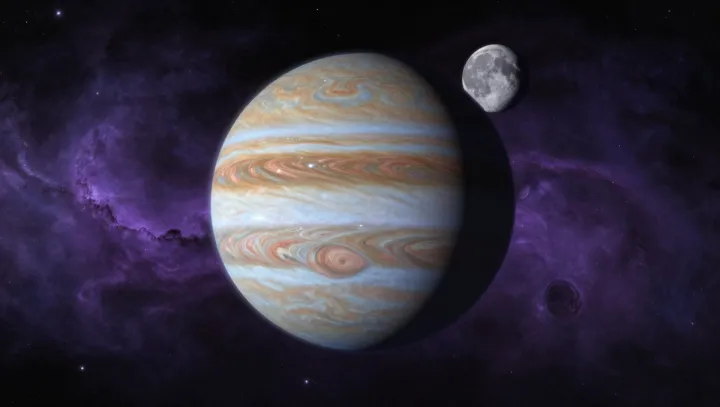
A gas giant can warm a moon without touching it. Beneath a cratered surface, its gravity can repeatedly squeeze and release rock and ice, turning orbital motion into heat. The result may be an ocean sealed under a frozen crust, where sunlight never reaches and the apparent stillness conceals a restless interior.
The orbit makes the difference. When a moon follows an elliptical path, its distance from the planet changes, as does the strength of the gravitational pull across its body. This produces tidal flexing: the moon deforms as it travels, and friction within its materials converts some of that motion into heat. The process is called tidal heating. Other moons can help maintain orbital eccentricity through gravitational interactions, preventing the orbit from becoming nearly circular and the flexing from fading.
Heat alone guarantees nothing. Whether an ocean survives depends on how much energy the moon generates and loses, as well as the composition and thickness of its ice. Jupiter's moon Europa is a leading example: evidence from its surface and magnetic measurements supports an ocean beneath its shell, though the ocean's properties remain uncertain. Tidal heating helps explain how liquid water could persist so far from the Sun. On such a moon, a scarred face can hide a sea.