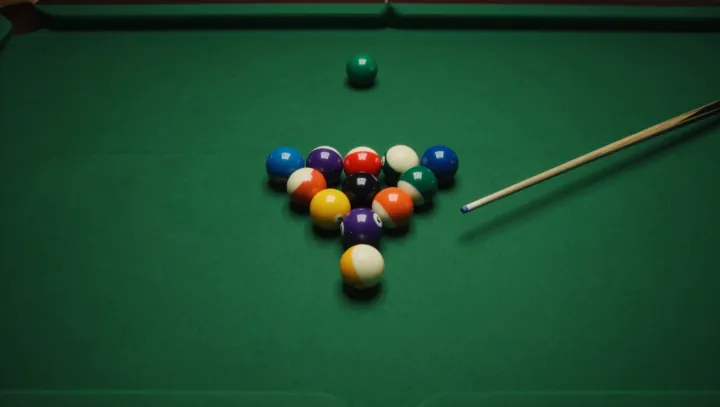
A stopped cue ball can still have somewhere to go. Strike it below center and it acquires backspin; send it squarely into a numbered ball, and it can briefly lose nearly all its forward speed before rolling backward. The trick lies in what the collision does not take away.
Pool rewards control over force. A player uses a cue stick to drive the cue ball into numbered object balls, but the goal depends on the game: in eight ball, players generally work through their assigned group before pocketing the eight; in nine ball, the lowest numbered ball must be struck first. Position matters. A ball pocketed with no thought for the next shot can leave a difficult table, while a controlled draw can bring the cue ball back toward a useful position.
The physics is less mysterious than the result looks. In an approximately head-on collision between balls of equal mass, much of the cue ball's forward momentum transfers to the object ball, while angular momentum remains in its backward rotation. Cloth friction then acts on the spinning cue ball, pulling it backward until it rolls away. Timing matters. Backspin wears off as the ball travels, so distance, cloth conditions and the force of the stroke affect the result. Hit too far below center and the tip may slip, causing a miscue. On the table, a moment of stillness can conceal a return already in motion.