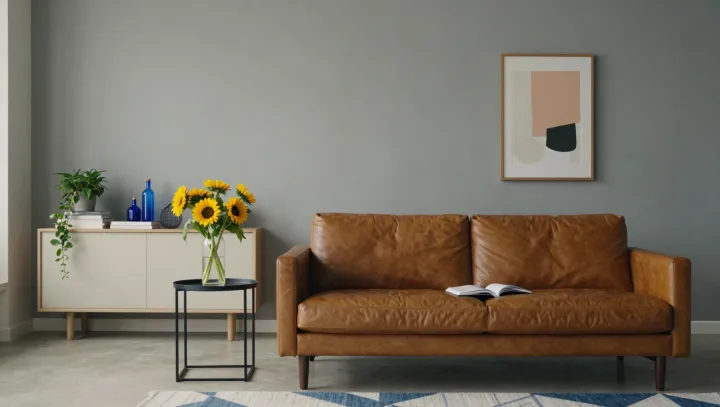
A few sunflowers can give a gray room more visual energy than a brightly painted wall. Their yellow petals stand out against pale gray, drawing the eye precisely because the surrounding color is restrained. The room does not need more color everywhere. It needs contrast in the right places.
Restraint is doing the work here. Against a neutral background, a saturated accent can appear especially vivid, an effect associated with simultaneous contrast: the appearance of a color changes with the colors beside it. A room covered in strong hues offers less quiet space against which any one color can distinguish itself. The brown leather sofa adds warmth without challenging the flowers for attention, while the pale walls give both elements room to register.
Blue accents make the yellow more persuasive, not less. Positioned alongside warm flowers, the cooler color sharpens the distinction between them; greenery adds another natural hue without demanding the same attention as the petals. Proportion matters as much as hue. Too many yellow objects could turn a pointed accent into a uniform field, while a few carefully placed touches let the eye move between color and calm. The result is not a room overflowing with brightness, but one in which brightness has somewhere to land.