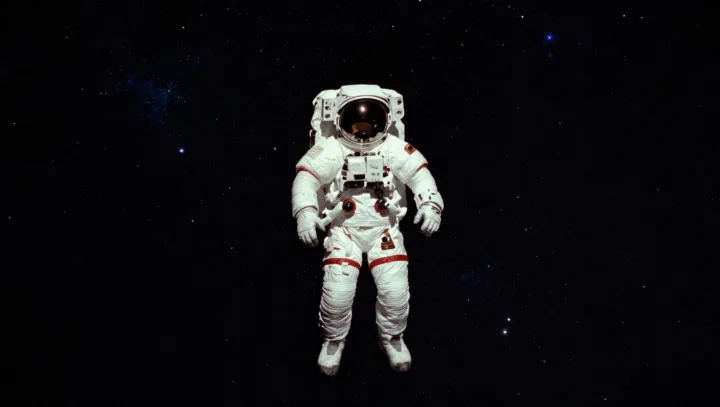
Bruce McCandless did not need air to fly. He needed something to throw away. Wearing a maneuvering unit outside the shuttle Challenger, the astronaut fired jets of nitrogen into the vacuum, trading a little gas for the ability to move without a tether.
The physics is less mysterious than the photograph suggests. Newton's third law says that expelling gas in one direction produces a force in the other; conservation of momentum accounts for the exchange between astronaut and propellant. Small thrusters on the backpack provided that force, while hand controllers let McCandless command movement and rotation. There was no atmosphere to push against. Nor was there much drag to slow him down: once moving relative to the shuttle, he would continue until another force changed his motion.
Distance made precision more valuable, not less. McCandless and the shuttle were both moving in orbit around Earth, so his task was to control their motion relative to each other rather than simply hover in place. A mistimed burst could increase their separation or leave him moving toward the spacecraft too quickly. He traveled roughly three hundred feet from Challenger before returning, testing a system designed to help astronauts work away from the cargo bay. The image looks like an escape from gravity. It is also a portrait of restraint: a figure suspended above Earth, free to move only by accounting for every push.