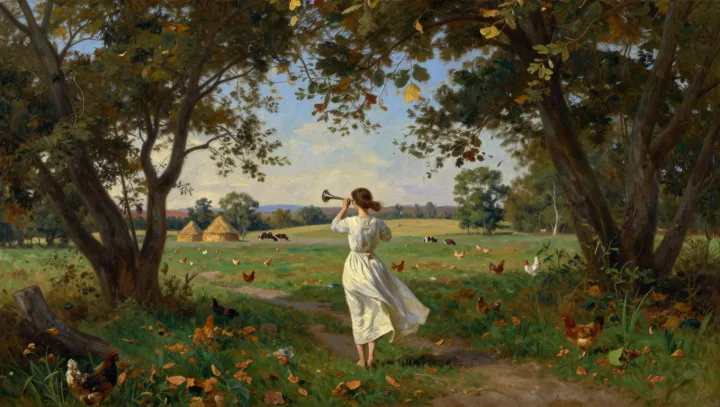
A long, curved horn lifts toward an empty sky, and a young figure braces against the effort of blowing it. In Winslow Homer’s painting, the blast that never reaches the viewer’s ears stands at the center, not as ornament but as infrastructure. The image captures a world in which sound, not machinery, synchronized fields, kitchen, and farmhouse.
The dinner horn functioned as an acoustic signal system, an early form of distributed information before telegraph networks and standardized factory whistles. A single note moved across acreage like a broadcast, regulating work intervals and mealtimes. Economic historians would recognize in this routine a form of temporal discipline, as clear as any punch clock, while sociologists might call it a low‑tech protocol for managing labor allocation and social hierarchy in a dispersed household economy.
Homer’s choice of a quiet farm scene after recent conflict redirects attention from battlefield spectacle to the hidden logistics of peace. The girl becomes an operator within a communication grid, yet the device is handmade, muscle powered, and bound to local topography and weather. Where urban timekeeping leaned on precise mechanical oscillation and tariff schedules, rural coordination depended on breath, acoustic resonance, and memory. The painting holds this tension between informal custom and emerging modern time regimes in a single suspended call, already fading as new technologies approached.