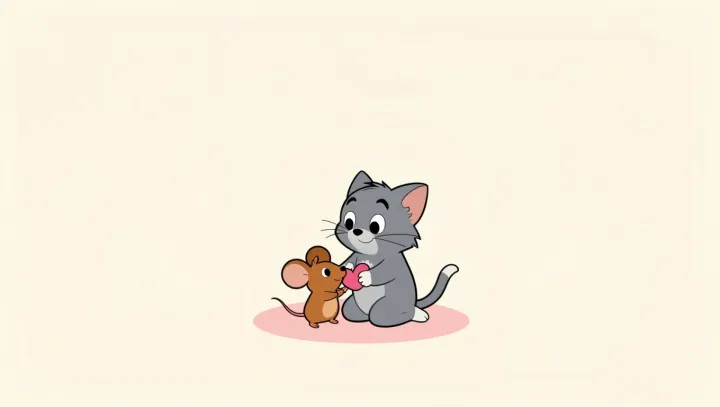
Cartoon physics in Tom And Jerry looks absurd, yet your brain quietly signs off on every collapsing staircase and airborne piano. The reason lives less in equations of classical mechanics and more in the way your visual cortex and predictive coding systems compress reality into fast, usable guesses about motion and cause.
Animators build a coherent micro-universe with its own rules: momentum exaggerates, elastic collisions overshoot, gravity waits half a beat. Once that rule set is stable, your brain treats it like a local physics engine, updating internal models by Bayesian inference rather than by checking Newton’s laws. Timing, arcs of movement and conservation of silhouette keep kinematics legible, so even when mass, acceleration and entropy run wild, causal structure stays crystal clear.
Neuroscience shows that perception is not a camera but a negotiation between sensory input and prior probabilities. Tom And Jerry exploits those priors: characters squash instead of shatter, survive instead of bleed, and always reset to a recognizable baseline. The outcome space narrows, prediction error drops, and the chase feels intuitively “right” even as real-world constraints evaporate into dust clouds and perfectly cat-shaped holes in the wall.