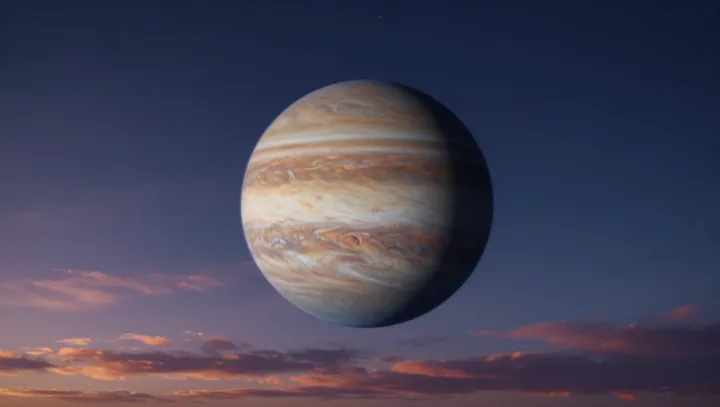
Thin light writes thick weather. On a frigid gas giant far from its star, sunlight is weak, yet the planet’s own rotation and internal heat field seize that faint energy and stretch it into global cloud bands that echo the striped face of Earth’s jet streams.
The surprising part is not that storms exist out there. The surprise is how familiar the physics looks once pressure, rotation rate, and gravity lock into certain ratios that atmospheric dynamics treats almost like a template. In the deep hydrogen envelope, radiative cooling at the top and internal heat flux from below set up convection, and those rising plumes meet the Coriolis force, which shears them sideways into zonal jets that wrap the planet.
Those jets are the real sculptors. Short-lived eddies spin off from them, then merge, transferring angular momentum in a way geophysicists describe with baroclinic instability and potential vorticity conservation, and from that bookkeeping emerge long, narrow bands where ammonia or methane condense into clouds. Between bands, sinking air dries out, sharpening the contrast much as subtropical highs sharpen deserts on Earth.
Storms then become almost unavoidable. Where jets collide or kink, vorticity piles up and organizes into vortices that can span continents, their growth limited less by energy supply than by the finite width of the jet corridors themselves, leaving a frozen world that, in its cloud geometry, feels unsettlingly close to home.