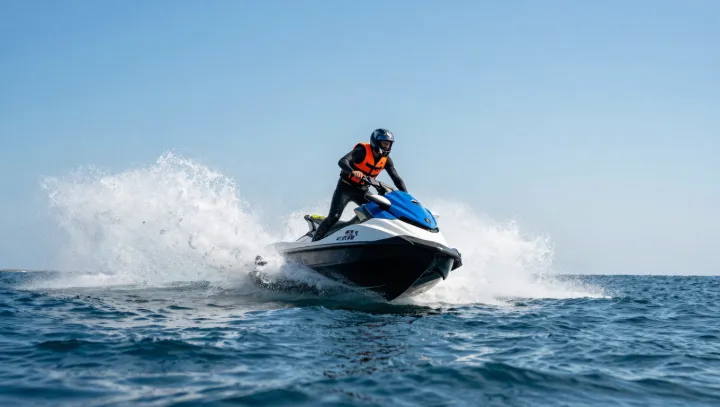
That first hard launch is closer to takeoff than to casting off. A jet‑ski does not push water aside like a displacement hull; it accelerates by expelling water through a high‑velocity jet, creating pure thrust along its centerline, much as a small aircraft rides the reaction force from a propeller wash or turbofan exhaust.
The strange part is that the engine itself is ordinary. The drama comes from what that internal‑combustion crankshaft is coupled to. Instead of a propeller hanging in open water, the engine spins an axial‑flow pump inside a duct, the water‑jet unit, which sucks water from beneath the craft and fires it aft. That jet produces a concentrated momentum stream, giving sharp throttle response and a feeling of being pushed from behind, rather than dragged through the water.
Speed on a jet‑ski feels airborne because the hull mostly stops being a boat. At higher velocity the craft enters planing, where hydrodynamic lift supports most of its weight and only a small area touches the surface, similar in spirit to an airfoil generating lift in air. With less wetted surface, drag drops, small steering inputs bite instantly, and every wave acts like a bump of turbulent air, so the rider experiences quick yaw, pitch and roll changes that resemble low‑level flight more than any afternoon in a conventional powerboat.