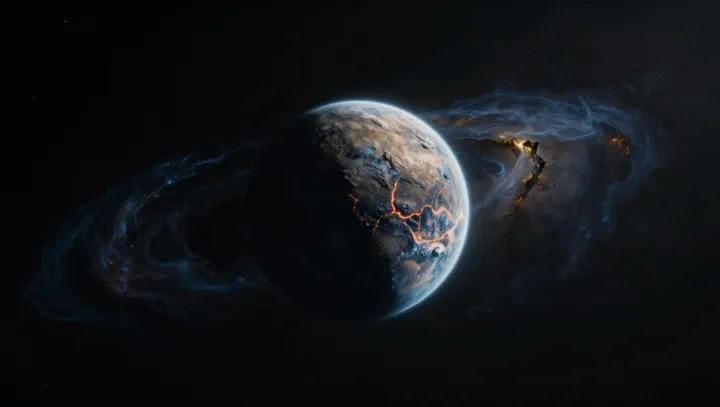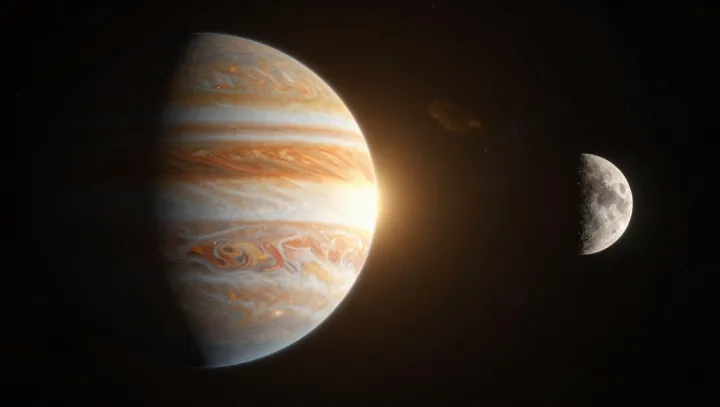
Gravity looks boring on your desk and ruthless in deep space. A phone simply accelerates downward, yet a gas giant wears gravity as architecture, with broad bands and storms locked into place. The same law sits underneath both scenes: Newton’s inverse‑square dependence of force on distance.
What feels like a straight plunge is just the simplest solution to that equation, where Earth’s mass dominates and air resistance trims the motion into a clean drop. Scale the system up and strip away drag, and the mathematics does something less obvious. Curved paths emerge from the same formula once sideways velocity enters the balance between gravitational potential energy and kinetic energy.
Jupiter’s stripes are not painted by a different force; they are fluid dynamics playing inside one gravitational well. Rotating gases obey hydrostatic equilibrium and conservation of angular momentum, so slight differences in temperature and composition shear into jets that wrap the planet. Farther out, a moon that is launched with just the right tangential speed locks into orbital mechanics so stable that its trajectory can stay phase‑matched with its planet for spans that dwarf any human record.