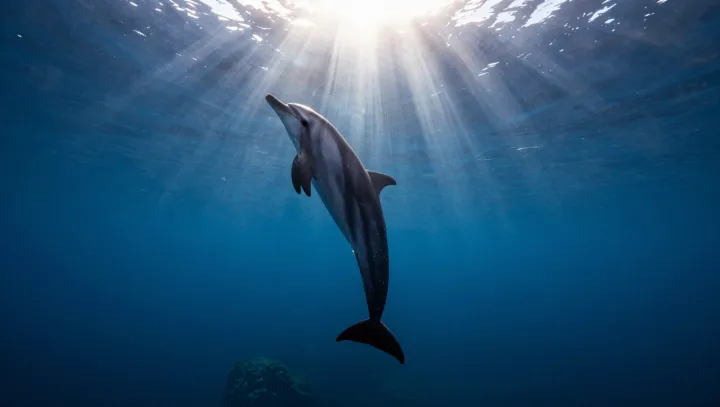
Size, here, is not excess; it is economy scaled up. As a whale shark rises through the blue, water pours into its mouth and over gill rakers that act as a living sieve, capturing zooplankton and small nekton while most of the fluid exits cleanly, a filtration system so efficient that each slow beat of its tail moves a food factory forward.
The real trick is not appetite but restraint. With a metabolic rate far below that of smaller, faster sharks, and with tissues tuned for aerobic respiration rather than bursts of anaerobic sprinting, this fish burns energy slowly enough that millions of microscopic prey items add up, its bulk functioning as storage and thermal inertia rather than as an energy drain.
Vertical commuting, not random wandering, shapes its day. By cruising in cooler, deeper layers where cellular processes run cheaply, then gliding upward to plankton‑rich, sunlit water when feeding density justifies the trip, the animal exploits a classic bioenergetic gradient, paying minimal locomotion costs for maximal intake as currents concentrate drifting life ahead of its open jaws.