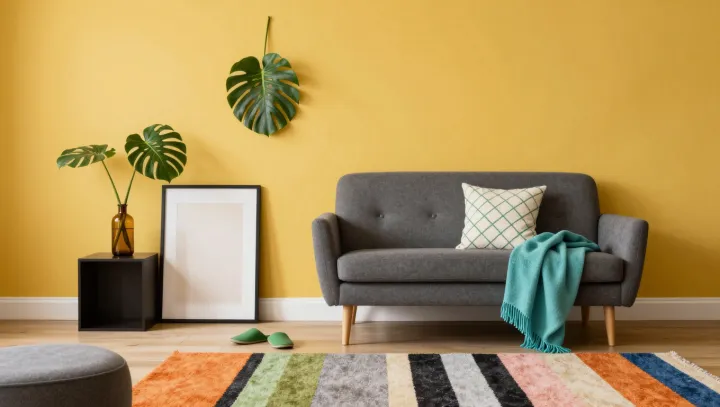
The gray sofa does the quiet work in a colorful room. Against a yellow wall and repeated touches of green, its restrained surface gives the eye somewhere to rest. That pause matters: contrasting colors can feel deliberate rather than scattered when a substantial piece of furniture holds the composition together.
Neutral is not the same as invisible. Gray has low chroma, so it competes less for attention than a saturated yellow or green, while its size gives it visual weight. The sofa can sit between the brighter hues without asking to match either one. Repeated green accents, meanwhile, create a visual link across the room; they make the color feel like a choice rather than an isolated interruption. The result is not a perfect formula, and the balance will shift with the amount of each color and the light falling on it.
The wrong gray can still unsettle the arrangement. A sofa with a cool undertone may sharpen the contrast with a warm yellow wall, while a warmer gray can soften it; neither is automatically better. Lightness matters too. A dark sofa can ground a bright wall, whereas a pale one may give the room a more open feel. Fabric samples viewed beside the wall and green accents can reveal relationships that a single swatch cannot. Leave room for surprise. In the space between the wall and the sofa, the colors keep their voices without having to speak at once.