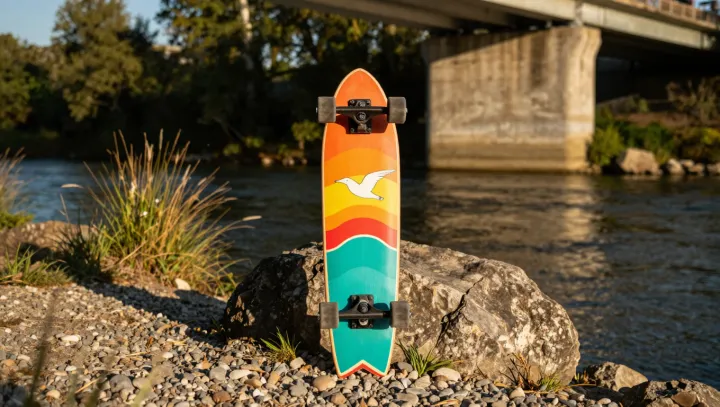
A cruiser skateboard chooses the journey over the trick. Its compact deck and large wheels are built for covering ground, not for making every flip effortless. The distinction matters on rough pavement, where a board designed for technical tricks can transmit more vibration and lose speed to small obstacles.
The wheels do much of the negotiating. Larger wheels roll over cracks and pebbles more readily because their diameter reduces the angle at which they meet an obstacle. Softer urethane, measured by durometer, deforms against uneven surfaces and absorbs some vibration, though it can also increase rolling resistance. There is a price. Larger wheels generally add weight and rotational inertia, making the board harder to spin or flip quickly than a comparable setup with smaller wheels.
The compact deck is a compromise, not a magic carpet. Its shorter length can make a cruiser easier to carry and maneuver through tight spaces, but it may offer less room for foot placement than a larger board. Many cruisers have a kicktail for lifting the front wheels or turning sharply; others have little or no tail, limiting certain tricks. Deck contours vary too, and a flatter shape can give feet less leverage for flips. Wheel clearance matters: if a wheel contacts the deck during a turn, the sudden friction can stop the board. For all its color, the cruiser makes a quiet argument about skating: sometimes the pavement itself is enough.