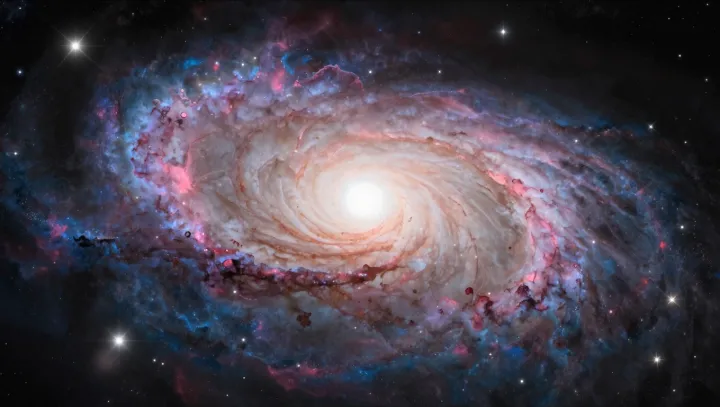
A spiral arm is not a permanent chain of stars. It is a pattern. In a galaxy whose bright central bulge is surrounded by sweeping arms, individual stars can follow their own orbits while the arrangement of light remains recognizable. The apparent contradiction rests on the difference between matter and the shape it makes.
The distinction is easier to grasp with a crowd than with a photograph. A traffic jam can persist even as cars enter and leave it; likewise, density wave theory describes an arm as a region of enhanced density through which stars and gas can move. Gravity helps organize that pattern, while differential rotation means material closer to the galactic center generally orbits at a different angular speed from material farther out. Gas compressed in an arm can form new stars. The brightest are short lived, so their light often traces the places where they were born, making the arm stand out against the disk.
No single mechanism, though, explains every spiral. Computer simulations suggest that some arms are transient structures that emerge, change shape and fade, rather than enduring waves with a fixed rotation rate. Interactions with neighboring galaxies and gravitational instabilities within a disk can also help produce or renew them. The distinction matters: a galaxy can remain visibly spiral even when a particular arm does not last. In the illustration, the curves seem settled; the stars that draw them are not.