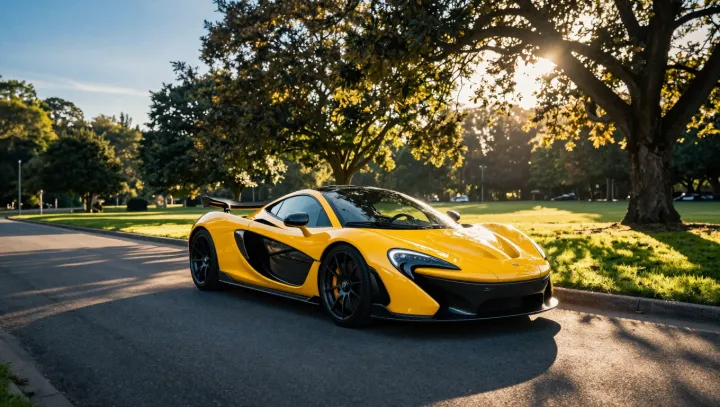
The wing's grip comes with a bill. On a yellow and black supercar, a towering rear wing pushes the car toward the road, helping its tires resist sliding. Yet the same device also resists forward motion, even if its surface is polished smooth. The cost is built into the airflow.
Smoothness cannot repeal induced drag. The wing creates a pressure difference between its upper and lower surfaces and redirects air upward; in return, the air pushes the wing downward. Near the tips, air moves from the higher-pressure side toward the lower-pressure side, feeding trailing vortices. They leave their mark. These vortices alter the local airflow, tilting part of the aerodynamic force backward as well as downward. That backward component is induced drag, not merely friction against the wing's surface. The wing also adds profile drag through skin friction and pressure losses, even when its finish is smooth.
More downforce is not free speed. Extra load generally increases the rear tires' available grip, though not in exact proportion because tires become less efficient as load rises. Downforce and aerodynamic drag both grow roughly with the square of speed, while the power needed to overcome drag rises roughly with the cube. Angle matters too. A steeper wing can generate more downforce, but it usually brings more drag and, if pushed too far, may stall as airflow separates. On a circuit, that exchange can make a car faster through bends but slower along straights. The wing remains poised between two ambitions: to hold the road and to slip through the air.