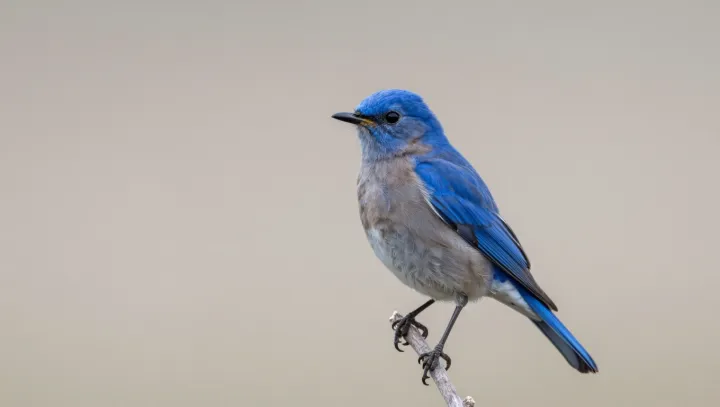
The mountain bluebird wears a color it does not possess. Its blue comes not from blue pigment, but from microscopic structures in its feathers that redirect light. In the male, that optical effect produces a sky-colored coat above pale underparts, a striking signal across the open country of North America.
The feather's architecture does the work. Within its barbs, a spongy layer contains keratin and tiny air spaces arranged at a scale comparable to wavelengths of visible light. Light scattered by these structures interacts through coherent scattering: waves of some wavelengths reinforce one another, while others largely cancel. The result favors blue light returning to the eye. Melanin, a dark pigment beneath the spongy layer, absorbs much of the stray light that might otherwise wash out the color. Without that dark backing, the blue would appear less saturated.
This is color as an event, not an ingredient. Unlike many pigments, which selectively absorb light because of their chemical properties, structural coloration depends on the physical arrangement of material and the light falling upon it. The male's blue is generally less iridescent than the shifting colors of a hummingbird, although illumination and viewing conditions still affect its appearance. Females are typically more subdued, with gray-brown plumage and touches of blue. On an exposed branch, a male can seem to carry a fragment of sky; the color exists in the meeting of feather, light and eye.