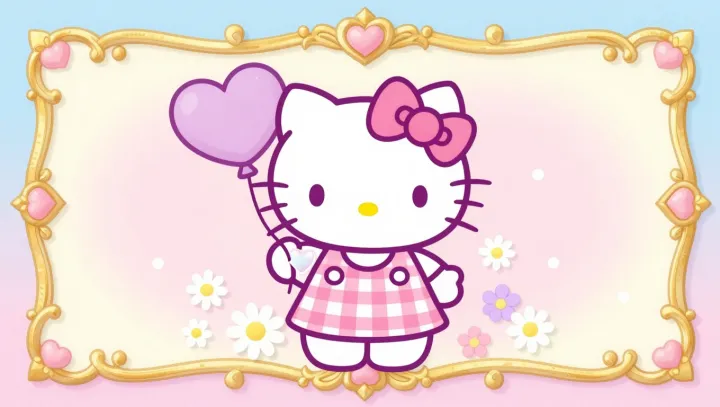
Hello Kitty's missing mouth is her most expressive feature. Dressed in pink gingham and framed by flowers, hearts and gold ornament, she offers no fixed smile to tell the viewer how to feel. That restraint is deliberate, at least in Sanrio's explanation: the company says her expression leaves room for people to read their own emotions into her face.
The design makes identification unusually easy. A smiling character can seem indifferent to a sad child; Hello Kitty's unchanging face can sit beside happiness or disappointment without appearing to contradict either. In visual communication, this openness invites projection: viewers supply a mood that the image itself does not specify. Her simple features help, too. They are recognizable on a coin purse or a large display, while the absence of a spoken expression reduces dependence on any particular language.
Still, a blank mouth is not a passport on its own. Licensing, merchandise and Sanrio's distribution helped carry the character to audiences worldwide; the design gave those audiences a flexible way to receive her. Nor will everyone see the same emotion in her face. That is the point: inside the ornate border, the smallest absence leaves the largest space for the viewer.