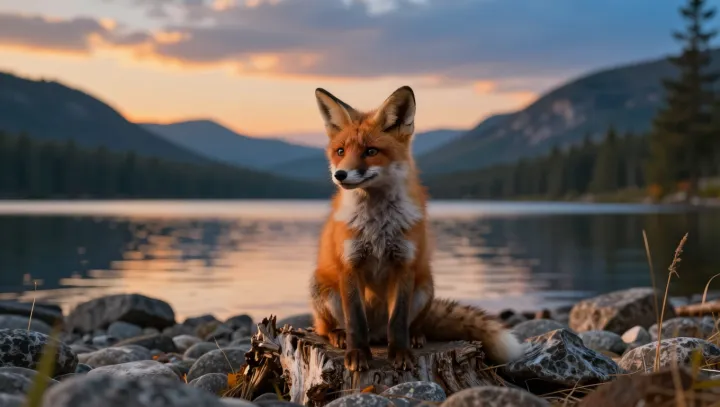
That fox on the ridge is not being poetic. It is running a field exercise that quietly decides whether it will live long enough to breed, because height, airflow, and dim light together create a brutal but efficient classroom. From an elevated perch, the animal extends its visual horizon and widens the angle at which its compound sensory inputs overlap, so slight motion in grass or a shadow against the sky becomes easier to resolve than it would be at ground level.
More important is what the nose and ears are doing. A crosswind sliding over open ground brings a layered signal of volatile odor molecules; the fox is effectively sampling a moving gradient, refining olfactory discrimination in conditions biologists describe with terms like turbulent diffusion and scent plume structure. At the same time, low ambient light forces higher reliance on rod photoreceptors and on auditory cues, pushing neural circuits for depth perception and sound localization into overdrive while the risk from larger predators is still manageable.
This is not leisure. It is calibrated exposure. By choosing a high, open perch rather than a thicket, the young fox trades some concealment for better early warning, testing how fast it can parse conflicting inputs when a rustle might be a mouse, an owl, or nothing at all. Each dusk on that exposed ledge, the animal is quietly upgrading a survival algorithm written in muscle, retina, and cortex.