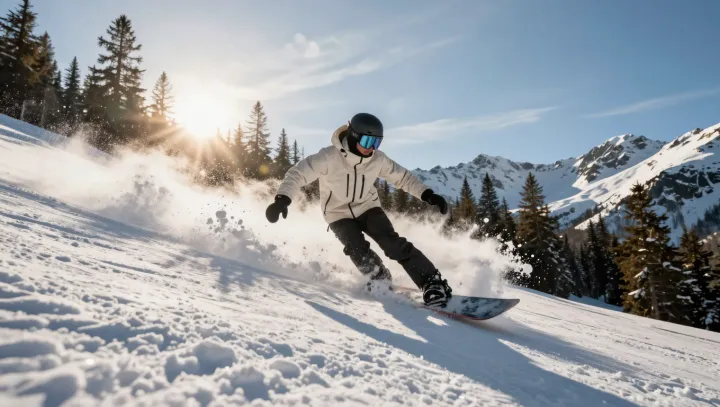
Soft fabric, harder carves. That trade sounds backwards until you watch what a rigid shell actually does in deep powder: it bridges across your torso, creates dead spaces, and shoves cold snow air straight through every gap the moment you lay the board over.
The smarter move is a jacket that bends, wrinkles, and balloons on purpose, because that shape-shifting builds a dynamic air buffer instead of a static wad of padding. As you initiate a carve, the articulated panels and low-modulus face fabric deform around your ribs and shoulders, shrinking and expanding micro-cavities that trap air. Those pockets slow convective heat loss and cut wind penetration far more effectively than just stacking another slab of synthetic fill, which often compresses exactly where you are working the hardest.
Control improves for the same reason. A flexible pattern with mapped stretch at the elbows and lats reduces torsional resistance, so your upper body can counter-rotate without fighting your own shell. Less internal friction means finer edge angles and quicker pressure shifts, especially when the snow is three-dimensional and the board is submarining through soft layers. Combine that with a breathable membrane and targeted venting and you get a microclimate that actively circulates warm air as you move, rather than a stiff bunker that only feels thick until the first cold plume of powder punches through it.