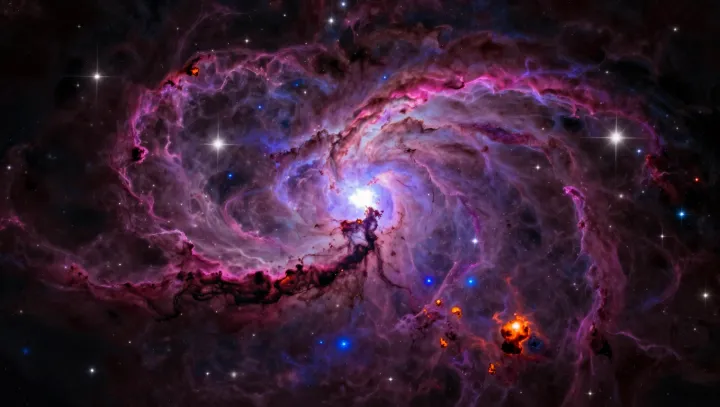
A twisted cloud does not choose between shadow and light; it enforces both. Packed knots of molecular hydrogen and dust grains grow so dense that visible photons are stopped cold, their paths ended by absorption and scattering inside compact cores where protostars feed on infalling material and remain invisible to optical telescopes.
Yet the same physics turns that apparent blackout into a luminous sketch of violence. Where outflows from those hidden protostars ram into thinner gas, shock fronts heat atoms and ions, driving emission lines of hydrogen, oxygen and sulfur that carve razor-thin filaments along the shock surfaces, each strand tracing gradients in density, temperature and magnetic field geometry with almost cartographic precision across the cloud.
The real trick is that darkness and glow are just two settings of radiative transfer through an inhomogeneous medium. In the most opaque clumps, high optical depth traps starlight and even reprocessed infrared, while along fractured edges and cavities the same photons escape after being re-emitted, turning the boundary walls into backlit screens that reveal ionization fronts and turbulence otherwise hidden to direct sight.