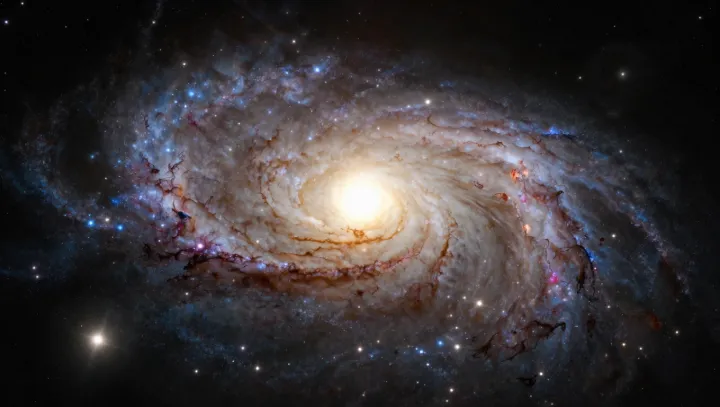
Spiral arms are less like objects than like instructions. Across a galaxy, gravity sets up a standing pattern called a spiral density wave, and that pattern, not the individual stars, is what turns slowly through the disk like a vast traffic jam shifting along a highway.
The counterintuitive part is simple. Space dominates. Matter is rare. Yet a slight enhancement in mass density, locked into a rotating gravitational potential, can steer orbits. Stars follow nearly Keplerian orbits around the galactic center, but when they cross the density wave they bunch up, slow slightly, and brighten the arm with short-lived, high-mass stars triggered by gas compression and shock fronts in the interstellar medium.
The stronger claim from theorists is that dark matter is the quiet architect. Its halo fixes the overall rotation curve and helps maintain the quasi-stationary wave pattern predicted by Lin–Shu density wave theory. Individual stars and gas clouds enter and leave the arm, yet the phase pattern of the wave, and thus the visible spiral, can persist over many orbital periods, resembling a jam that crawls while cars come and go.
So a galaxy that is mostly vacuum still sculpts order: not by spinning as a solid disk, but by letting gravity write a slow, repeating pattern into the emptiness.