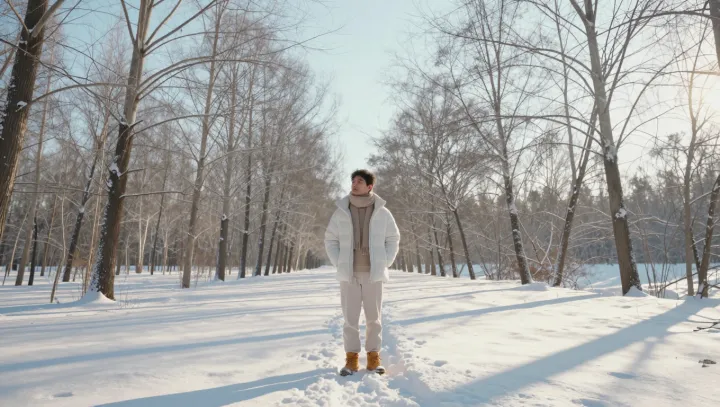
Snow, not the outfit, does the heavy lifting on camera. In open daylight, a snowfield behaves like a colossal white reflector, bouncing diffuse light upward into every shadow on a cream coat or sweater, while the sky and sun still pour directional light from above and behind.
That means a supposedly low-contrast scene is anything but. The snow’s high albedo floods the foreground with fill light, lifting midtones so fabric texture and seams stay visible instead of sinking into mush on the histogram, yet the subject’s back still catches a brighter band of illumination from the sun at a grazing angle.
Out of that geometry comes the surprise: a clean outline. When the sun or even a bright overcast sky sits behind the subject, it creates backlighting that wraps around shoulders and hair, generating a thin rim light where the luminance gradient is steepest between body and background. Sensors love that edge.
The camera’s auto exposure then joins the act. Faced with a frame dominated by white, it often underexposes slightly, protecting highlights in the snow, which deepens any subtle warm tint in the cream outfit and increases apparent contrast at the boundary lines, even as the overall scene stays bright enough to feel airy.
So a pale coat in a white field ends up more defined, not less. The snow fills, the backlight carves, the exposure dials down just enough, and what looked like visual camouflage on the hanger becomes a sharply traced figure against an illuminated stage.