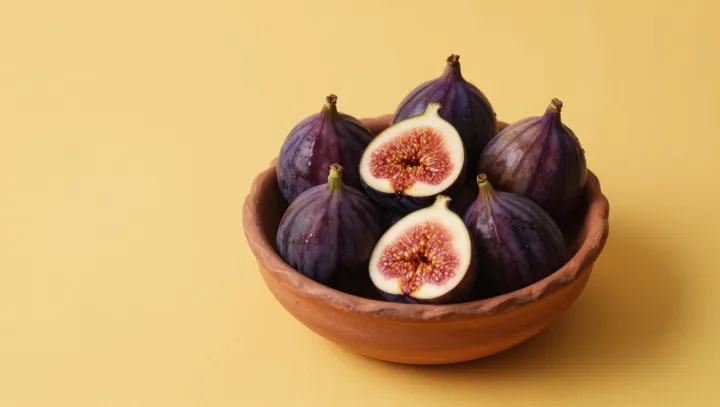
Yellow makes figs flare. At the cut edge, a deep-purple skin and pink-red flesh can look newly charged when a yellow plate, cloth, or graphic border sits beside them, because vision judges color relationally rather than as pigment in isolation. The effect is not frivolous.
The trick is physiological. In opponent-process theory, cone photoreceptors feed neural channels that compare signals rather than merely tally light: a blue-yellow channel registers yellow nearby, while red-green and luminance signals help define the fig's crimson and near-violet boundary. Contrast does the rest. Through simultaneous contrast, the yellow surround biases perception at the edge, making the cooler blue component within purple feel stronger and giving adjacent pink-red areas a sharper, less muted presence. This is edge work. The brain prioritizes local differences, which is why a yellow frame can make a modestly colored fruit appear almost electrically assertive.
The lesson is slightly rude. A fig does not need a change in chemistry to look more intense; it needs a neighboring hue that presses the visual system to separate signals, an operation refined for detecting boundaries, surfaces, and ripeness under unstable light. Yellow is a provocateur. Because it is broadly opposed to violet on the color wheel, it raises the perceptual stakes around purple, though the pink-red interior responds through related contrast effects rather than a single neat complementary pairing. Nothing stays merely seen. On the plate, the fruit becomes an argument between photons and the mind that sorts them.