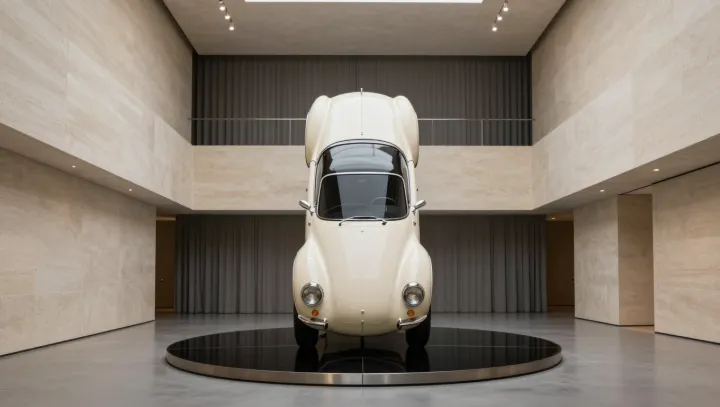
The car becomes a statue. Set on its tail, a familiar automobile loses the horizontal bargain that makes it legible as transport: cabin, hood, wheelbase, and overhang cease to describe motion and begin to declare mass, void, and balance. Gravity changes the argument. The center of gravity, ordinarily hidden beneath the floor and judged for stability, now reads as a compositional problem, while the greenhouse appears less as glazing for occupants than as a cutout pressed into a solid.
That reversal is revealing. A car's conventional side view is a contract with airflow, visibility, packaging, and crash structure; turned upright, it becomes a study in proportion, exposing how the beltline pinches the body, how surfacing directs the eye, and how wheel arches function like carved apertures. The wheels lose their job. Without road contact, their circularity no longer promises traction and instead frames the body as a plinth frames a figure, making even stamped steel feel modeled rather than assembled. The monocoque, built to distribute loads through defined load paths, acquires the calm of an armature. This is not an argument against engineering. It is an argument that engineering has always carried aesthetic force, concealed by speed and familiarity. Suspended there, the vehicle asks an awkward question: was it ever merely a machine?