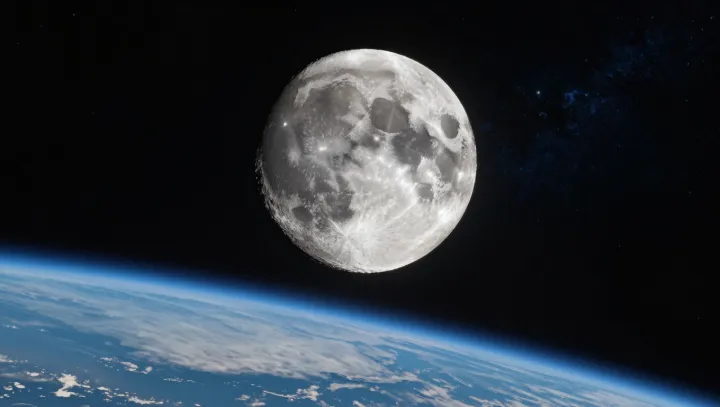
The Moon bears an inconvenient resemblance to Earth. Lunar rocks share isotopic fingerprints with Earth's mantle, even though many models of a giant impact suggest that much of the Moon should have come from the body that struck our planet. The match is striking. Explaining it without discarding the impact hypothesis remains a test of planetary science.
The resemblance is more than cosmetic. Isotopes are varieties of an element with different numbers of neutrons, and their relative abundances can preserve clues to where material formed in the early solar system. Measurements of oxygen isotopes in lunar samples and terrestrial mantle rocks show a particularly close match. Yet an impactor formed elsewhere might have carried a distinct signature, leaving the Moon measurably different from Earth. That expectation complicates the story. The outcome depends on the impact conditions and the composition of the objects involved.
The proposed answers are as revealing as the puzzle. In some models, the impactor and Earth began with similar compositions; in others, the collision generated enough heat and mixing to produce a more uniform disk of material from which the Moon formed. Neither explanation is settled. Researchers compare simulations with isotopic measurements and other constraints, including the Moon's chemical composition, to see which histories remain plausible. Each account must explain both the resemblance and the differences between the two bodies. A collision may have made a neighbor, yet the rocks still ask whose substance survived.