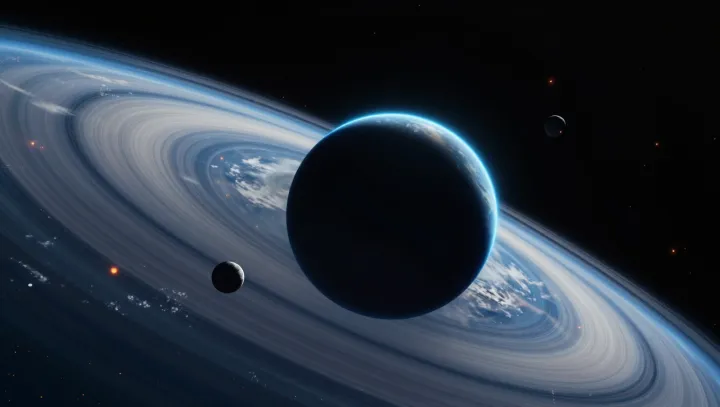
A planet can be too powerful for its own moonmaking. In the imagined illustration, a ring circles a planet beneath a vast planetary backdrop, with small moons nearby. The scene raises a question: why does orbiting debris remain scattered in one place while gathering into moons in another?
The answer lies in a contest, not a lack of gravity. Close to a planet, tidal forces pull more strongly on the near side of a clump than on its far side. Within the Roche limit, those differences can overwhelm the self-gravity of a loosely bound object, hindering its growth or tearing it apart. Farther out, the tidal difference weakens, allowing particles that collide gently enough to stick and grow through accretion. Distance changes the balance. The limit is not a fixed wall: it depends on the densities and physical strength of the orbiting material.
The divide is less tidy than the illustration suggests. Small, solid bodies can survive inside the Roche limit because material strength helps hold them together, while rings can also exist beyond it. Moons may shape rings through orbital resonance, repeatedly nudging particles and opening gaps, rather than simply marking a boundary where debris becomes a satellite. Nor must every ring produce a moon: collisions, the supply of material and its orbital motion all matter. In the image, a thin band and scattered companions make that competition visible; the planet holds them all, but not in the same embrace.