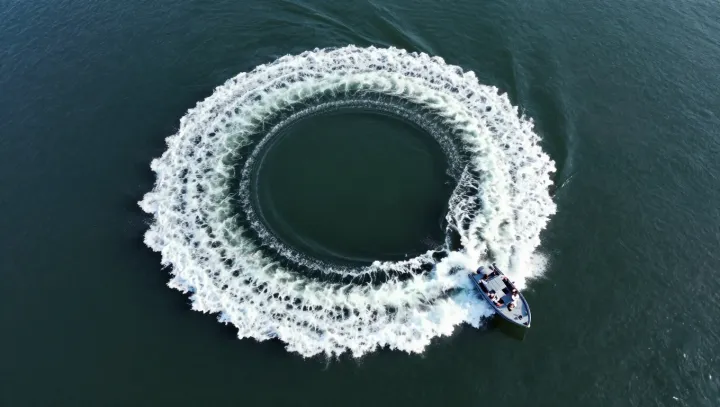
The circular wake is less a trail of traveling water than a record of a boat's force. Its white arc stays visible after the hull has moved on, because waves carry energy away from the turn while bubbles and disturbed water remain near the surface. The distinction is easy to miss.
The waves do not need to take the water with them. As surface waves pass, water parcels mostly move in small orbits rather than traveling with the wave across the water. There can still be some net drift and local currents, especially near the boat. But the moving pattern is not simply a mass of water following the hull. During a tight turn, waves generated along the curved path overlap, creating the conspicuous ring.
Foam tells a different story. The propeller and hull churn air into the water, producing bubbles that rise through buoyancy and collect at the surface. Turbulence spreads them, and substances in the water can make some bubbles last longer before they burst. The foam eventually thins as bubbles break and currents disperse them; the waves, meanwhile, lose energy through spreading and friction. What remains for a while is a pale inscription made by motion, not a circle of water pursuing its maker.