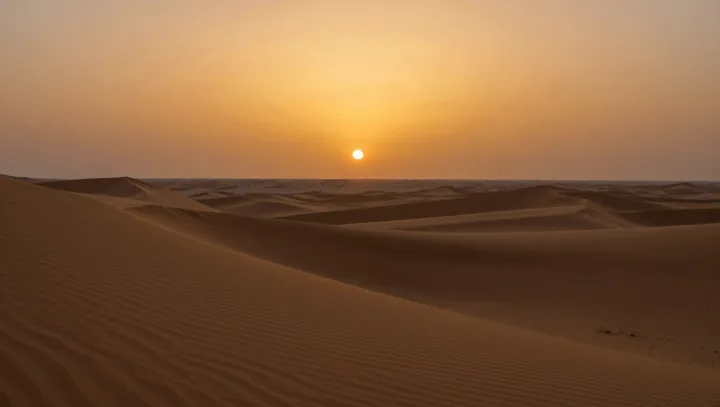
A dune travels without taking a single stride. At sunset, light picks out ripples on its windward face, where grains are lifted, dropped and lifted again. Each hop is short, but the cumulative effect is not: sand shifts toward the crest, and the dune slowly advances in the direction of the prevailing wind.
The movement is less mysterious than it looks. In a process called saltation, wind lifts sand grains briefly into the air; when they land, their impacts can dislodge others. Some grains roll or creep along the surface instead. As this traffic carries material up the gentler windward slope, grains accumulate near the crest. On the sheltered side, the wind weakens, and sand tumbles down the steeper slip face. Repeated avalanches deposit material there while wind removes it from the opposite side. The dune's shape persists, though its constituent grains are constantly being rearranged.
Size changes the pace. Smaller dunes generally migrate faster than larger ones because less sand must be moved to shift their profile a given distance. Wind strength, sand supply, moisture and vegetation also affect movement; a dune held by roots may barely travel at all. The fine ripples visible in low light have their own motion and can move across the dune's surface much faster than the dune itself. By sunset, what appears fixed is already being remade, one brief flight at a time.