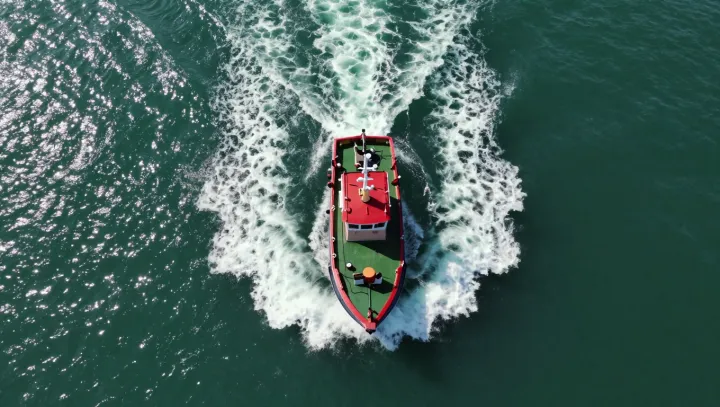
A faster boat need not leave a wider wake. Behind the red and green vessel, swirling white water makes the motion look chaotic, yet a boat traveling steadily through deep water can produce an outer wave pattern whose angle scarcely changes with speed. The reason lies not in the hull alone, but in how gravity waves travel.
The fixed angle is a trick of dispersion. In deep water, longer gravity waves travel faster than shorter ones, and their group velocity, the speed at which wave energy moves, is half their phase velocity. As the boat accelerates, it generates a larger pattern with longer waves; the relevant speeds scale together, preserving the geometry of the outer boundary. For an idealized, steadily moving source, that boundary lies about nineteen and a half degrees from the direction of travel on either side. The full wedge spans roughly thirty nine degrees. The scale changes, not the angle.
The visible wake is less obedient. A real hull spreads its disturbance over a finite length, and at high speeds its strongest waves can cluster inside the theoretical boundary, making the wake look narrower. Shallow water changes the dispersion relation, while turns disrupt the steady pattern on which the calculation depends. Foam adds another complication: the white churn immediately behind a maneuvering boat is not a reliable outline of the gravity wave wedge. Beyond that froth, the water carries a quieter geometry.