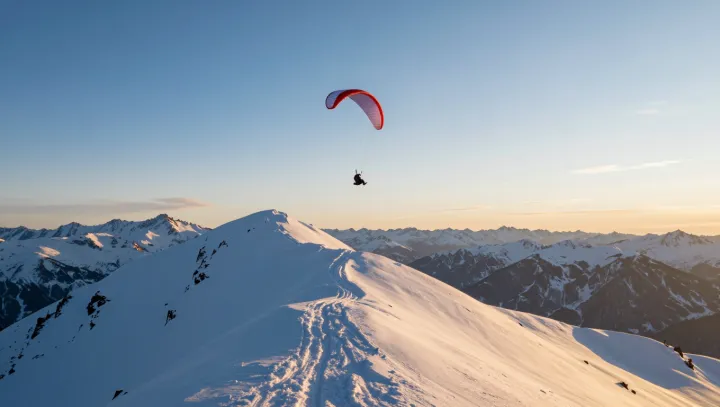
Snow on a ridge is not just scenery; it is a blunt instrument that sculpts the air. Cold, reflective slopes sharpen temperature contrasts, so wind hitting the ridge is forced upward in a tight ribbon called ridge lift, a band of rising air that can extend for many kilometers along the spine of a mountain.
The efficiency looks almost unfair. A paraglider wing, essentially a soft aerofoil with high aspect ratio, converts that narrow upward push into sustained flight by trading altitude for speed in tiny increments, balancing lift, drag, and wing loading with such precision that sink rate can fall below one meter per second while the surrounding air climbs faster than that.
The real trick is that the air is not just going up; it is structured. Snow-covered terrain enhances thermal gradients, creating embedded thermals inside the ridge lift flow, so pilots can shift a few meters upwind or downwind and move between laminar or turbulent zones, exploiting orographic lift and convective updrafts almost like stepping between lanes on an invisible highway.
Staying aloft for hours is less magic than disciplined energy accounting. By flying close to the ridge, where vertical velocity of the air peaks, and then gliding out during brief transitions, pilots keep their glide ratio and polar curve working in their favor, burning altitude only when the air’s own upward motion offers a better return on every meter surrendered.