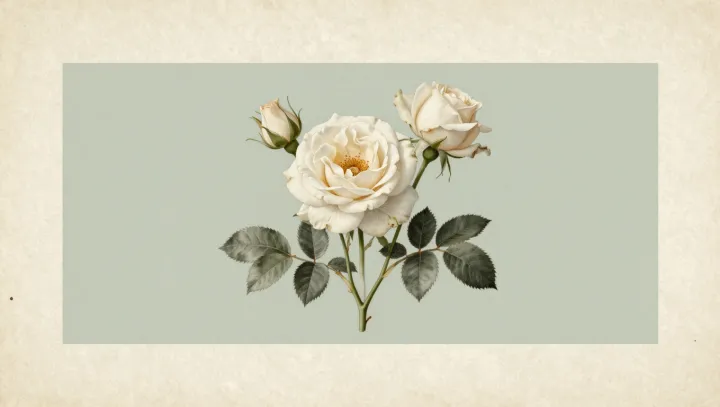
The vase holds dissent. One white rose stem can carry a clenched bud, a loosening cup, and a flower spread wide because it is usually a spray: several flower buds, not one bloom, share a branched axis. They did not begin together. Each lateral bud passed through development on its own schedule, shaped by position, light before cutting, and the stem's stored carbohydrates.
It is biology. Rose sprays exhibit phenological asynchrony: terminal and lateral buds are initiated, supplied, and released from dormancy at different rates. Apical dominance, mediated chiefly by auxin, can hold side buds back while the leading bud advances. Cut at a mixed stage, the stem carries its earlier stagger into water. Turgor pressure matters. Water uptake keeps petals expanding, yet xylem embolism or bacterial blockage can starve the hungriest flower first, leaving one bud stalled as its neighbor opens.
Uniformity would be the stranger sight. Once severed, every bud draws on a finite pool of water and soluble sugars, but its demand depends on how far its petals, sepals, and reproductive tissues had already formed. Ethylene can hasten senescence, while cool storage slows respiration and preserves the lag between buds. The vase is no laboratory. It is a small theater of uneven clocks, where one branch keeps its secret closed as another spends itself in light.