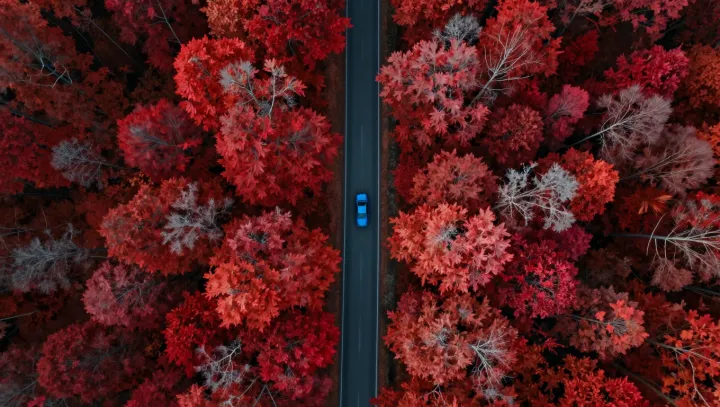
The car cannot hide. Against a nearly continuous canopy of red foliage, its blue body cuts through the scene because the eye reads the cool-warm split as a high-priority visual event, not as another decorative detail. Red dominates the field. Blue refuses to blend.
This is physiology, not magic. Opponent-process theory describes how visual pathways compare blue-yellow and red-green signals, while simultaneous contrast can make the isolated blue appear more intense when it is ringed by warm color. The effect resembles an interrupt signal in computing: visual salience pushes the blue object ahead of the background before slower, deliberate attention has time to weigh the full scene.
The contrast carries consequences. A driver, pedestrian, camera, or image-recognition system can locate the vehicle faster when hue separation remains strong, although shadows, glare, dust, and distance can weaken that advantage. Chromatic adaptation may soften the red field over time. The blue remains the abrupt exception, a small cold signal lodged inside a wall of heat.