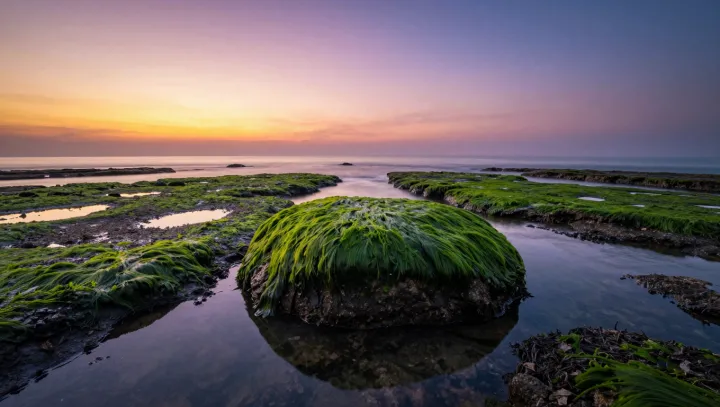
The ocean makes its own blue. A clear sky can strengthen the color, but it is not the whole explanation: even beneath a gray sky, deep, clear water can appear blue because water itself absorbs some colors of sunlight more readily than others.
Water is no passive mirror. Sunlight contains a range of visible wavelengths, and as it travels through water, molecular absorption removes more red and orange light than blue. This selective absorption is linked to the vibrational behavior of water molecules. Some of the light that remains is scattered back toward the surface, where it can reach an observer. A glass of water looks nearly colorless because light travels through too little of it for the effect to be obvious; across many meters, the difference becomes much easier to see.
The planet's portrait is less uniform than its nickname suggests. Oceans cover about seventy percent of Earth's surface, yet clouds obscure portions of them, and sunlight reflected by the atmosphere contributes to the view from space. Near shore, suspended sediment can turn water brown or green; microscopic organisms containing chlorophyll can alter its color, too. Depth matters as well. In shallow water, light reflected from sand or coral may produce a pale turquoise that has little in common with the dark blue of the open ocean. Seen from afar, the blue planet is not a single color but a shifting record of what sunlight meets on its way back into space.