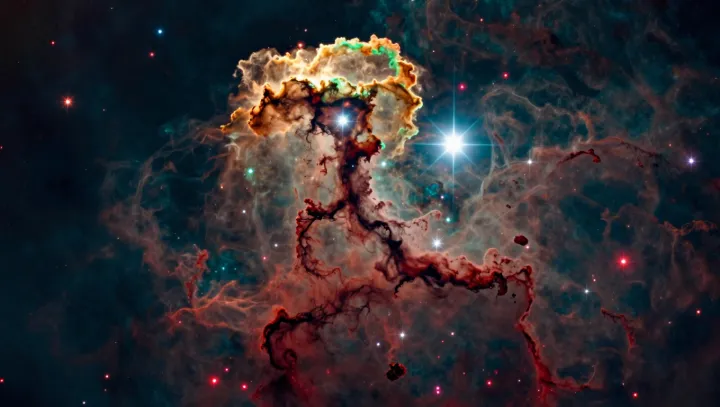
The darkest parts of a nebula may be its busiest nurseries. Dust blocks visible light from whatever lies behind it, but that same obscurity helps protect the cold gas from which stars can emerge. Darkness has a purpose. Against a crowded field of stars, glowing gas and black clouds show only part of the story.
Concealment is less an obstacle to star formation than a condition that can favor it. Dust grains absorb ultraviolet radiation that would otherwise break apart molecules, allowing molecular hydrogen and other compounds to persist within a cloud. Dust also helps the gas cool by radiating energy away. Colder gas offers less pressure against gravity, so a sufficiently dense region can collapse. Gravity takes over. As material falls inward, it gathers into a protostar, which grows hotter and denser as it gains mass from its surroundings. Not every dark patch will produce a star; the outcome depends on the cloud's density, temperature and motion.
The hidden birth is not beyond inspection. Infrared light passes through dust more readily than visible light, and telescopes can detect infrared emission from warm material around young stars. Radio observations can reveal cold molecular gas, giving astronomers another way to trace the material available for collapse. Each view has limits. Thick dust can still obscure the innermost regions, while a bright patch of gas does not by itself establish what lies inside. What appears in visible light as an absence can hold a star still gathering its substance.