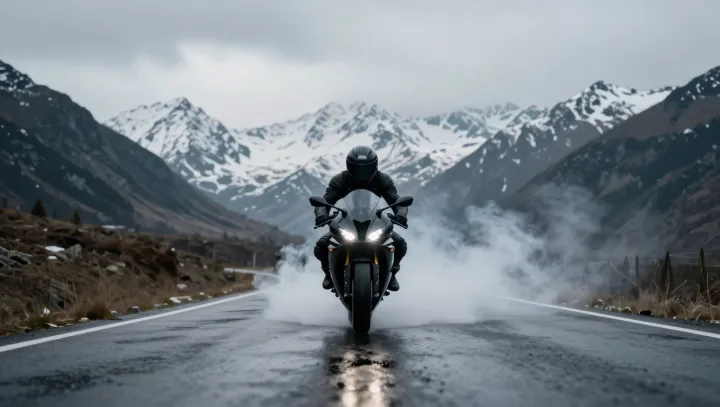
Smoke from a rear tire on a wet mountain road looks like a physics failure, yet it is physics that keeps the bike up. The contact patch is tiny, and that saves it; energy is concentrated into a strip of rubber only a few centimeters wide, not the whole tire at once.
The key idea is brutal and simple: frictional work turns into heat faster locally than grip disappears globally. Under a burnout, shear stress and a high slip ratio dump power into the top micrometers of tread. That thin layer can reach temperatures that vaporize surface moisture and volatile compounds, creating visible smoke, while bulk rubber and carcass stay relatively cool and stiff enough to transmit lateral force.
Equally counterintuitive is that some heat actually helps. Rubber is viscoelastic; its hysteresis loss and glass transition temperature set how it deforms over asphalt microtexture. Cold tread can be too rigid, riding on peaks of aggregate. As it warms, it conforms to roughness, increasing real contact area and adhesive friction, even as the outer skin is being abraded and scorched.
Water does not win everywhere at once. The rotating tire pumps liquid out through grooves and centrifugal acceleration, so the leading edge of the contact patch may still cut through a thinning film. Within that patch, different zones see different slip: the rear can be near-saturated longitudinal slip for show, while the front tire, cooler and less abused, carries most of the lateral load that actually keeps the motorcycle from sliding off the road.