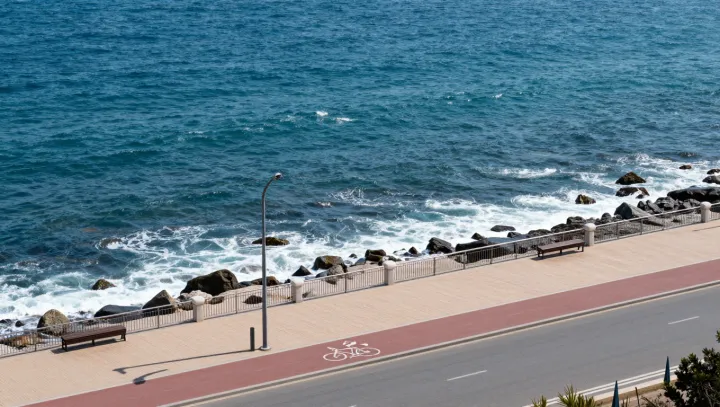
A protected shore can come at another shore's expense. Above waves breaking against rock, a promenade offers benches and a cycle path; beneath that calm arrangement, any seawall or other hard defense may change how water and sediment move along the coast. Protection, in other words, has boundaries.
The wall is not a sediment trap by design, but it can become part of the problem. Waves striking a seawall may reflect seaward, stirring sand at its base and causing scour. Meanwhile, longshore sediment transport carries sand and gravel along a coast as waves arrive at an angle. Where a structure interrupts that movement, material can accumulate on one side while beaches farther along receive less. The result is not automatic: wave direction, coastal shape and the availability of sediment all matter. Rock offers resistance too, though it does not behave like a sandy beach.
The best defense is therefore not necessarily the hardest one. Engineers can assess wave reflection, sediment supply and erosion beyond the protected stretch before choosing a response. Beach nourishment can replace lost sand, while dunes and vegetation may absorb wave energy where conditions allow; neither is a universal fix, and both need care over time. Monitoring neighboring shores also matters, because damage may appear beyond the project boundary. A bench above the breakers can seem to mark a line between land and sea; the water recognizes no such division.